
Quantum Computing Explained: Qubits, Entanglement and Encryption
A plain-English guide to quantum computers: qubits, superposition, entanglement and error correction, and why they matter for the encryption you rely on.
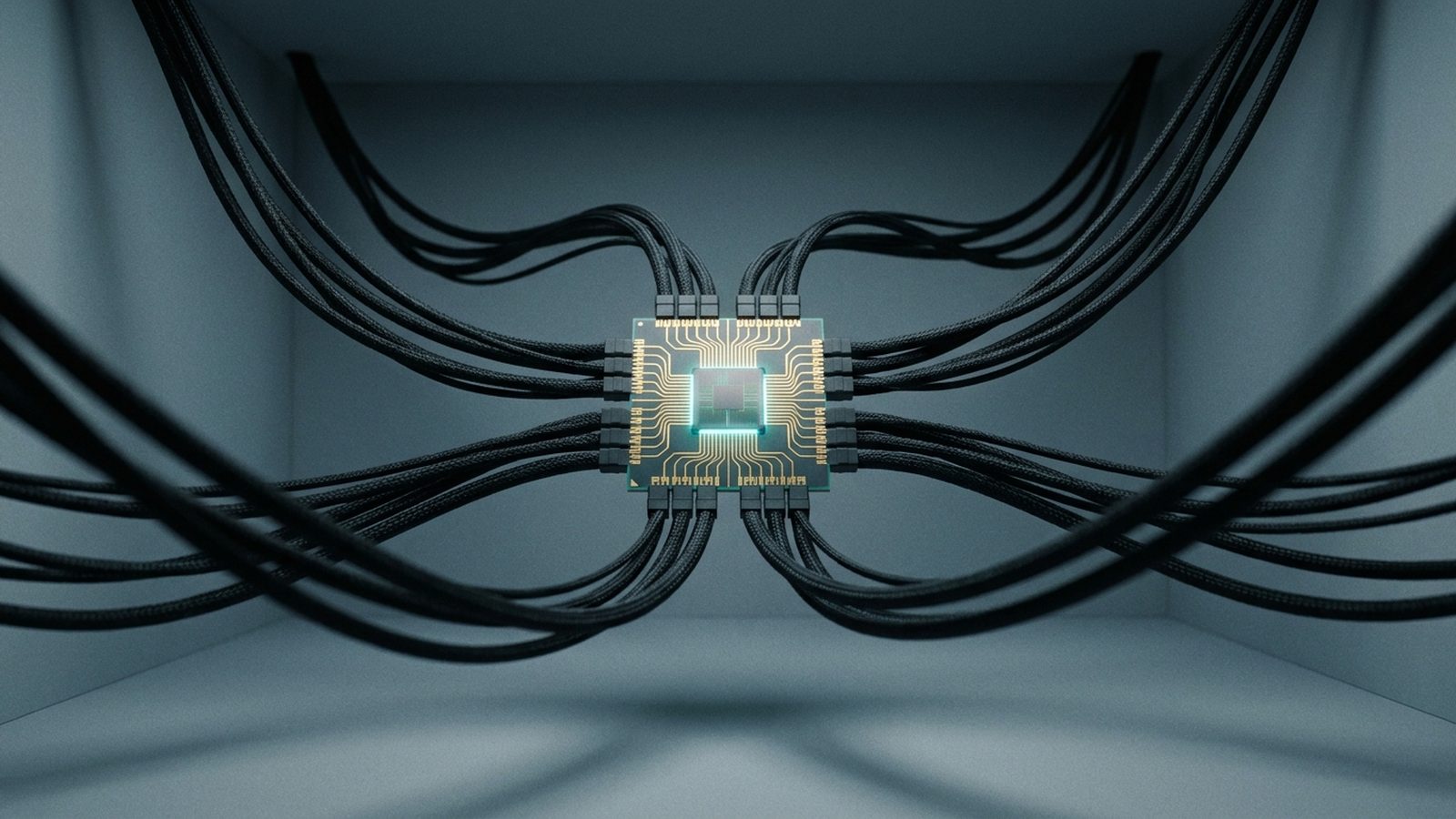
Quantum computing has a reputation problem. It is described either as magic that will solve everything or as hype that will never arrive. Neither is useful. The truth is narrower and more interesting: a quantum computer is a very specific kind of machine that is extraordinarily good at a few problems, and one of those problems happens to sit underneath most of the encryption on the internet.
This guide explains what a quantum computer actually is, without equations, and why a platform like VOIDEX treats it as a design constraint today rather than a headline for tomorrow.
Bits, and why they are not enough
Every computer you own works with bits. A bit is either 0 or 1, and everything your phone does, from rendering a photo to encrypting a message, is a long sequence of operations on those two values. Classical computers are astonishingly fast at this, but they still explore possibilities one path at a time, or a few thousand paths at a time across many cores.
For most tasks that is fine. For a small class of mathematical problems it is hopeless. Factoring a 2,048-bit number, for example, would take classical machines far longer than any human timescale. That hopelessness is not an accident. It is the foundation of RSA and elliptic-curve cryptography, which protect logins, payments, software updates and messages.
The qubit
A quantum computer replaces the bit with a qubit. Physically, a qubit can be many things: a tiny superconducting circuit cooled close to absolute zero, a single trapped ion held by electric fields, a particle of light, or a neutral atom held by lasers. What they share is that they obey the rules of quantum mechanics rather than everyday physics.
Those rules give a qubit three properties that matter.
Superposition
A qubit can be in a combination of 0 and 1 at the same time, described by two numbers called amplitudes. When you measure it, you get either 0 or 1, with probabilities set by those amplitudes. Before measurement, though, the qubit genuinely carries both possibilities.
A common mistake is to say this means a quantum computer "tries every answer at once". That is not quite right. You cannot simply read out every answer; measurement gives you one result. The skill of quantum algorithm design is arranging operations so that wrong answers cancel each other out and right answers reinforce, much like waves on water. That effect is called interference, and it is where the real power lies.
Entanglement
Two or more qubits can be entangled, meaning their states can no longer be described separately. Measuring one tells you something about the others, however far apart they are. Entanglement lets a register of qubits represent correlations that would need an exponentially large amount of classical memory to write down. Ten qubits span 1,024 amplitudes; three hundred qubits span more amplitudes than there are atoms in the observable universe.
Fragility
The third property is less glamorous. Quantum states are extremely delicate. Heat, stray electromagnetic fields and tiny imperfections in control pulses cause qubits to lose their quantum behaviour, a process called decoherence. Every operation also carries a small chance of error. Left alone, errors accumulate faster than useful computation can happen.
This is why the most important word in quantum computing is not "qubit". It is "error correction".
Physical qubits and logical qubits
Engineers deal with fragility the same way classical engineers deal with noisy radio links: redundancy. Many imperfect physical qubits are combined to encode one reliable logical qubit, and a continuous cycle of measurements detects and corrects errors without disturbing the stored information.
The most studied scheme is the surface code, which arranges qubits in a grid. It works only if the physical error rate is below a certain threshold. Below it, adding more qubits makes the logical qubit better. Above it, adding more qubits makes things worse.
In December 2024, Google Quantum AI announced its Willow chip and reported error correction below the surface-code threshold: as the encoded qubit grew larger, the logical error rate fell. That is a milestone the field had pursued for decades. It does not mean a code-breaking machine exists. It means the core engineering path toward one is no longer theoretical.
Newer approaches aim to need far fewer physical qubits per logical qubit. Codes known as QLDPC (quantum low-density parity-check) codes are an active area. In February 2026, Iceberg Quantum's "Pinnacle" design used them in a simulated architecture estimated at under 100,000 physical qubits for breaking RSA-2048, a result summarised by The Quantum Insider. That was a simulation, not hardware, and it should be read that way.
What quantum computers are good at
Quantum computers will not make your email faster or your games smoother. They are expected to excel at a narrow set of problems:
- Simulating molecules and materials, because nature itself is quantum. This is the application many researchers care about most.
- Certain optimisation and sampling problems, where the evidence of real advantage is still being debated.
- Problems with hidden periodic structure, which is exactly the family that includes integer factoring and discrete logarithms.
That last category is the one security teams watch.
Why encryption is in the blast radius
Public-key cryptography rests on problems that are easy in one direction and hard in the other. Multiplying two large primes is easy; recovering them from the product is hard. Computing a point on an elliptic curve is easy; working backwards to the secret number that produced it is hard.
In 1994 Peter Shor showed that a large, error-corrected quantum computer could solve both of those reverse problems efficiently. Shor's algorithm turns them into a search for a repeating pattern, and interference makes that pattern stand out. We walk through it step by step in How Shor's algorithm breaks RSA.
The resource estimates have been falling fast. In 2019 researchers estimated about 20 million noisy qubits to factor RSA-2048. In May 2025, Craig Gidney of Google Quantum AI cut that to fewer than one million, running for under a week. In March 2026, Google Quantum AI reported that the 256-bit elliptic curves used by Bitcoin and Ethereum could fall with fewer than 500,000 physical qubits, and withheld the circuits while publishing a zero-knowledge proof of the result.
Not everything breaks. Symmetric ciphers such as AES-256 and hash functions such as SHA-256 face a different quantum attack, Grover's algorithm, which only gives a square-root speedup. Longer keys absorb it comfortably. We explain that in Grover's algorithm and AES-256.
So the weak point is specific: the moment two parties agree on a key or prove who they are using RSA or elliptic curves.
Why the timeline is already now
It is tempting to ask "when will a quantum computer break encryption?" and relax if the answer is "years away". That misses the real risk. Encrypted traffic can be recorded today and decrypted later, once the machine exists. Security professionals call it harvest now, decrypt later.
Standards bodies have responded. On 13 August 2024, NIST finalised its first post-quantum standards: FIPS 203 (ML-KEM), FIPS 204 (ML-DSA) and FIPS 205 (SLH-DSA). NIST's draft transition report, IR 8547, proposes deprecating quantum-vulnerable RSA and elliptic-curve algorithms after 2030 and disallowing them after 2035. These new algorithms run on ordinary computers. You do not need a quantum computer to defend against one.
How VOIDEX is built for a quantum future
VOIDEX was designed on the assumption that anything crossing a network may be recorded and kept. That shapes several layers of the Voidverse.
Hybrid key agreement. Every direct conversation in VOIDEX Messenger starts with a PQXDH-style handshake that combines classical X25519 with post-quantum ML-KEM-768. The resulting key depends on both, so an attacker must break both. If a future quantum computer defeats X25519, ML-KEM-768 still stands; if an unexpected flaw were ever found in ML-KEM, X25519 still stands.
Keys that keep changing. After the handshake, a double ratchet with post-quantum re-keying gives each message its own key. That provides forward secrecy and post-compromise security, so no single stolen key unlocks a whole conversation.
Quantum-aware identity. Device identities are signed with hybrid Ed25519 plus ML-DSA-65, and every device key change is appended to a public, append-only transparency log whose tree heads carry the same hybrid signatures.
Standards for groups. Groups and private VOIDEX Channels use MLS, the IETF standard RFC 9420.
Keys are created on members' own devices, and VOIDEX servers store only public keys and ciphertext. The cryptographic core is open source, and the full design is laid out in the public VOIDEX security report. One trade-off, stated plainly: the optional encrypted history copy that a member's recovery code can open is deliberately not forward-secret, because that is what lets the code open the past. VOIDEX never holds the code, and members can switch the history copy off.
The short version
- A qubit carries amplitudes for 0 and 1; entanglement links many qubits; interference turns that into answers.
- Qubits are fragile, so thousands of physical qubits may be needed for each reliable logical one.
- Error correction crossed a real threshold in 2024, and resource estimates for breaking RSA and elliptic curves have fallen sharply since.
- Public-key encryption is vulnerable; well-sized symmetric encryption is not.
- The defence exists, is standardised, and runs on today's hardware.
Quantum computing is neither magic nor myth. It is engineering, and it is progressing. The sensible response is to make sure the conversations you have now are protected for as long as they need to stay private.
VOIDEX is invite-only. Request an invitation, or read the VOIDEX security report to see exactly how your messages are protected.
Sources
- Google, "Meet Willow, our state-of-the-art quantum chip" (December 2024): https://blog.google/technology/research/google-willow-quantum-chip/
- Gidney, C. "How to factor 2048 bit RSA integers with less than a million noisy qubits" (2025): https://arxiv.org/abs/2505.15917
- The Quantum Insider, "Q-Day just got closer" (31 March 2026): https://thequantuminsider.com/2026/03/31/q-day-just-got-closer-three-papers-in-three-months-are-rewriting-the-quantum-threat-timeline/
- NIST Post-Quantum Cryptography Standardization: https://csrc.nist.gov/projects/post-quantum-cryptography/post-quantum-cryptography-standardization
- NIST IR 8547 (initial public draft, November 2024): https://nvlpubs.nist.gov/nistpubs/ir/2024/NIST.IR.8547.ipd.pdf
Enter VOIDEX
VOIDEX is invite-only and free, with no ads and no trackers. Messages are protected by hybrid post-quantum encryption (X25519 with ML-KEM-768) and checked against a public key transparency log. VOIDEX runs in your browser and as apps for Windows and Mac, with iPhone and Android on the way.
Explore the Voidverse
VOIDEX is one private universe: post-quantum encrypted messaging, an anonymous social layer, short video, collectibles and a private window onto the web.
Keep reading
Grover's Algorithm and AES-256: Why Symmetric Encryption Survives
Grover's algorithm speeds up quantum brute force, yet AES-256 stays strong. What the square-root speedup means and where the real quantum risk sits.
Harvest Now, Decrypt Later: Why Messages Need Post-Quantum Security
Adversaries store encrypted traffic today to read it once quantum computers arrive. How long your secrets must last, and how VOIDEX protects them now.
How Shor's Algorithm Breaks RSA and Elliptic-Curve Encryption
Shor's algorithm lets a large quantum computer break RSA and elliptic curves. How it works, what the 2025 and 2026 estimates say, and how VOIDEX responds.